
Corner Brace Fence Installation: Build It to Last

Updated: 4 days ago
A fence can have good wire and straight line posts and still fail if the corner cannot carry the load. Proper corner brace fence installation gives the wire tension somewhere solid to go, keeping the line tight instead of pulling the end post out of the ground. For farmers and livestock owners planning a project in Central Nebraska, the brace is not a finishing detail. It is the foundation of the whole fence system. This guide explains how bracing works, how H-braces compare with floating braces, and which installation details deserve the most attention. For the broader layout, materials, and site-planning picture, see Rapid Fence's guide to agricultural fence installation in Nebraska.
What Corner Brace Fence Installation Actually Does: How It Holds the Whole Fence Under Tension
A corner brace is a structural assembly that resists the pulling force created when fence wire is tensioned. The corner or end post receives that load, the horizontal brace and brace post spread it through the assembly, and the diagonal brace wire locks the two posts together. When those parts are set firmly and installed in the right relationship, the fence can stay tight. Without them, tension concentrates on one post and the line starts to lean, sag, or loosen.
The corner is the load-bearing point
Line posts mainly keep wire at the intended height and spacing. A corner, end, gate, or pull assembly has a different job: it must resist the accumulated tension of the wire run. That is why a fence may look sound through the middle but fail first at a corner. Each loose corner can transfer movement into the next section, creating a cycle of sagging wire, livestock pressure, and more movement.
The same principle applies to a long straight run. When a wire is terminated, pulled, or divided into sections, the end assembly must carry the force. A gate opening adds another high-stress point because the fence line stops and starts around the opening. A professional layout identifies those points before wire is installed rather than treating bracing as an afterthought.
How the brace assembly transfers force
A strong assembly works as a connected system:
The main corner or end post is set deep enough and tamped so it resists movement.
The brace post is placed in line with the fence and set to a similar standard.
The horizontal brace connects the vertical posts and keeps them working together.
The diagonal brace wire or cable converts movement into tension across the assembly.
The soil around each post provides the resistance that the wood and wire alone cannot provide.
There is no single post depth or brace design that fits every property. Soil type, moisture, terrain, wire type, fence height, livestock pressure, and the angle of the corner all matter. The USDA Natural Resources Conservation Service, for example, specifies different brace requirements for end, gate, corner, and pull assemblies in its high-tensile smooth wire fence specification. That is a useful reminder that a brace should be designed for the load and site, not copied from a generic diagram.
H-Brace vs. Floating Brace: Which Is Right for Your Terrain?
H-braces and floating braces both use a main post, a secondary support, and a tension member to resist fence pull. An H-brace uses two vertical posts joined by a horizontal member. A floating brace uses an angled support that transfers force to a foot or bearing point near the ground. The right choice depends on wire tension, corner geometry, soil stability, access, and how permanent the fence needs to be.
Brace type | How it works | Where it fits | Key caution |
H-brace | Two vertical posts are tied together with a horizontal brace and diagonal tension wire. | Permanent corners, ends, gates, pull points, and higher-load livestock fences. | Both posts need sound footing, proper spacing, and a tight connection. |
Floating brace | An angled strut transfers force from the main post to a ground-level bearing point. | Appropriate end or moderate-load applications when the ground can hold the foot securely. | The foot can shift if soil is loose, wet, disturbed, or exposed to livestock. |
When an H-brace is the better choice
An H-brace is often the conservative choice for a permanent perimeter fence, a corner that changes direction sharply, a gate opening, or a high-tensile wire system that will be kept tight. It provides a broad, visible structural connection and can be built as a single or double assembly when site conditions call for additional support. Deep sand, saturated ground, steep grade changes, and heavy livestock contact deserve special attention because they can increase movement at the post and bearing points.
Spacing and hardware should follow the design used for the specific fence. A Utah State University extension fact sheet on high-tensile electric fence installation notes that corner and end posts must handle the pressure of tensioned wire, and it describes both floating braces and H-braces as viable systems when built correctly. It also provides a detailed H-brace assembly method in the extension guide to high-tensile fence installation. Use published specifications as a starting point, then adjust for the property rather than treating one dimension as universal.
When a floating brace can make sense
A floating brace can be efficient on a moderate-load end or a straight section where the main post is well set and the ground-level foot will not move. It uses fewer vertical posts and can reduce digging in some layouts. It is not a shortcut for every corner, though. If a corner changes direction significantly, if several wires carry heavy tension, or if cattle can rub against the support, a more substantial H-brace may be the safer long-term design.
Ask three practical questions before selecting one:
Can the ground-level bearing point stay in place through wet seasons, frost movement, and normal traffic?
Will livestock be able to rub, push, or step on the brace?
Does the wire system create enough load that a single support would be marginal?
On a mixed project, the answer does not have to be the same everywhere. A contractor may use a stronger H-brace at corners, gates, and terminals, then use an appropriate floating or in-line assembly where the load and soil support it.
Need help choosing the right brace for your soil and fence type? Call Rapid Fence at (308) 223-1320.
Common Corner Brace Failures and What Causes Them
Most brace failures are not mysterious. They come from a weak connection, inadequate soil resistance, incorrect tension, or a design that does not match the fence. Finding the actual cause matters because simply tightening the wire can make a weak assembly move faster.
1. Posts are too shallow or poorly tamped
A post can look deep enough while loose backfill leaves a void around it. As the wire is tensioned, the post begins to lean and the soil settles further. NRCS construction specifications commonly call for at least 36 inches of post embedment for fence assemblies, with project-specific requirements for corner, brace, end, and gate posts. The exact depth for a Rapid Fence project should account for local soil, moisture, post size, and the fence load. The important point is that depth and compaction are structural details, not cosmetic ones.
2. The horizontal brace is weak or poorly connected
A small, cracked, undersized, or poorly pinned horizontal member cannot keep the two vertical posts working as one assembly. Nails or loose wire wrapped around the outside may appear secure but can allow the brace to slip. Proper pins, sound brace material, and a tight fit are essential. The horizontal member also needs to be placed at a useful height for the fence design, not wherever it is easiest to fasten.
3. The diagonal tension member is missing or loose
The diagonal brace wire is what locks the assembly against racking. If it is missing, installed in the wrong direction, or left slack, the post pair can spread or rotate. Over-tightening creates its own problem: it can pull the posts out of alignment before the fence wire is even tensioned. The goal is a rigid assembly with no unnecessary slack, not maximum force applied to every component.
4. Fence wire is tightened before the structure is ready
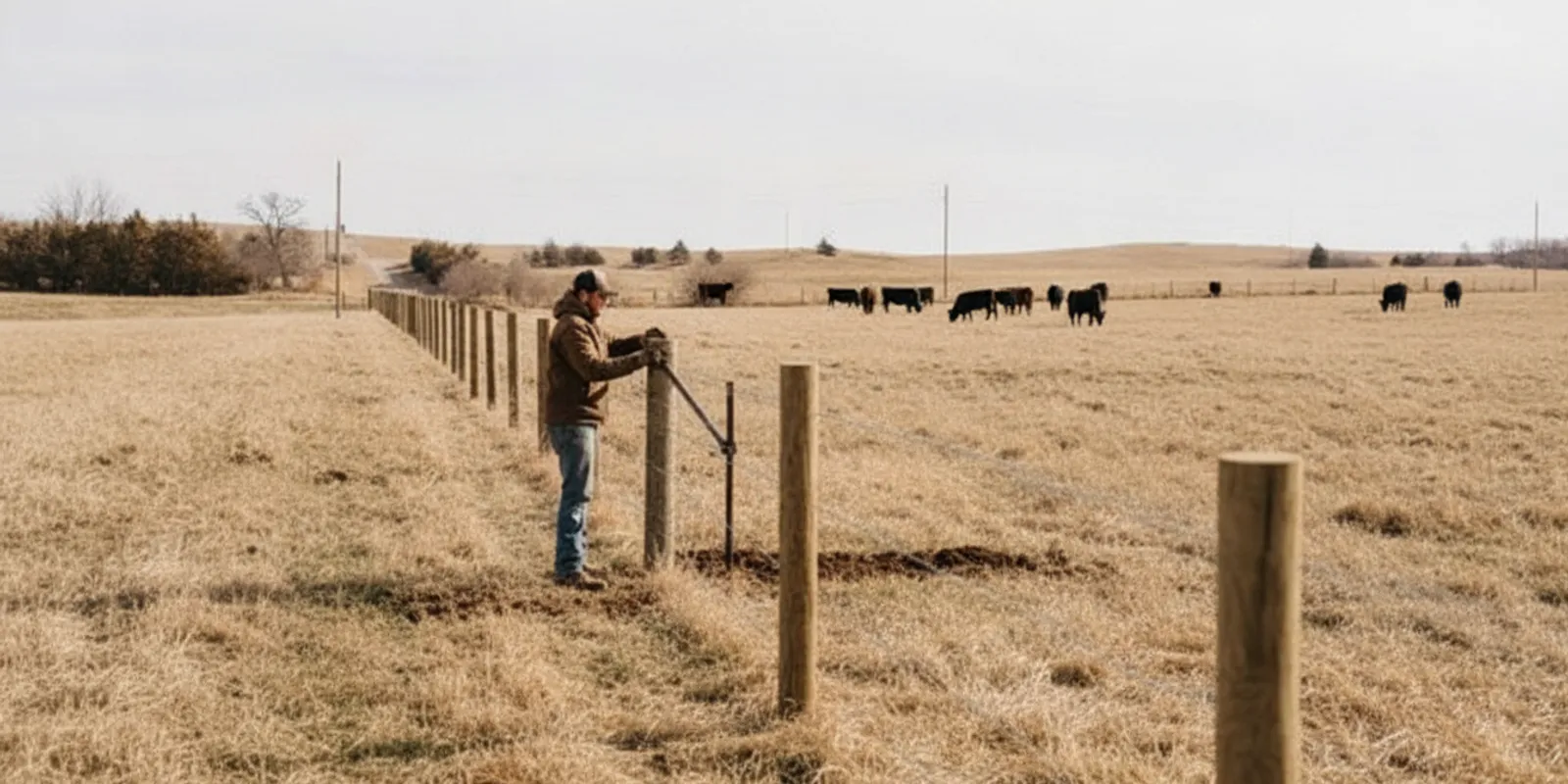
Wire should not be used to pull a weak brace into position. The corner assembly, gate posts, pull points, and line layout should be checked first. Tension is then applied in a controlled sequence so the installer can watch for movement. If the corner starts leaning during tensioning, stop and correct the structure instead of compensating with more wire or a temporary anchor.
5. The corner does not match the terrain or angle
A corner on a flat, firm pasture is not the same as a corner on a slope, in a low wet area, or at a sharp change in direction. Grade changes can increase the pull on the assembly, while soft soil can reduce the resistance around the post. A shallow turn may need a different approach from a near-90-degree corner. Site conditions should be read along the fence line before materials are ordered.
How Deep Do Corner Posts Need to Be Set in Nebraska Soil?
Corner posts need enough embedment and compaction to resist the combined pull of the wire, the terrain, and livestock contact. A common starting point is at least 36 inches for fence assemblies, but a durable Nebraska installation may require deeper or more substantial posts where soil is sandy, wet, disturbed, or exposed to high loads. The correct answer is a site and design decision, not one number for every farm.
Before setting the corner, evaluate:
Soil texture and whether the hole walls will hold during installation.
Seasonal moisture, drainage, and whether the area stays saturated.
Freeze-thaw exposure and the risk of seasonal soil movement.
Fence height, number of wires, and the tension required by the selected system.
Corner angle, slope, gate placement, and the length of the run.
Livestock behavior, including rubbing, crowding, and pressure near the corner.
Posts should be aligned before backfilling, and soil should be tamped in lifts so the post is supported throughout the hole. If the soil will not provide reliable bearing, the design may need a different assembly, larger structural members, additional bracing, or site preparation. Rapid Fence's farm fence post depth guide covers the broader post-setting questions, while a project evaluation determines what the corner itself needs.
What Separates a Properly Braced Fence from One That Fails in Two Winters?
A properly braced fence starts with a layout that identifies every load point, uses materials sized for the wire system, and treats soil preparation as part of the structure. The installer sets and compacts the posts, pins the brace securely, tensions the diagonal member correctly, and applies fence wire gradually while watching for movement. The result is a fence that stays tight because the whole assembly shares the load.
A fence that fails quickly often has one or more of these warning signs:
Corner posts lean toward the inside of the fence line.
The horizontal brace is loose, split, undersized, or attached without proper pins.
Wire is tight in the middle of the run but loose near the corner.
Gate posts move when the gate opens or closes.
Soil has washed away, settled, or stayed wet around the brace.
Livestock can reach and rub directly against the structural members.
A temporary repair was left in place as a permanent brace.
Good bracing also makes maintenance easier. When corners hold their position, line wires can be inspected and adjusted without chasing movement through the whole fence. That protects livestock containment and reduces the chance that one damaged section turns into a larger repair.
For a Central Nebraska farm or ranch, the best brace plan reflects the property. A barbwire perimeter, hi-tensile pasture fence, continuous fence area, and custom corral will not all use the same structural details. Rapid Fence serves operations around Scotia and across Central Nebraska, with established focus on Greeley, Buffalo, and Hall Counties. The team can assess the line, handle fence tear-outs or fence line cleaning when needed, and build the installation around local soil and livestock conditions.
Corner Brace Fence Installation FAQ
What is the purpose of a corner brace on a farm fence?
A corner brace resists the pulling force created when fence wire is tensioned. It transfers that force through the corner post, brace post, horizontal member, diagonal wire, and surrounding soil so the corner stays aligned and the fence line stays tight.
Is an H-brace stronger than a floating brace?
Neither design is automatically stronger in every situation. An H-brace provides two vertical posts and a horizontal connection, while a floating brace transfers force to a ground-level bearing point. Soil, wire tension, corner angle, livestock pressure, and installation quality determine which design is appropriate.
How deep should a farm fence corner post be?
At least 36 inches is a common starting point for fence assembly embedment, but the required depth can be greater for high-load corners, soft or wet soil, steep terrain, or heavy livestock pressure. A site-specific design is safer than applying one depth to every corner.
Where should a fence be braced?
Brace end posts, corners, gates, and pull or tension assemblies. Long runs may also need additional assemblies so wire tension does not accumulate over an excessive distance. The exact spacing depends on fence type, terrain, wire system, and the project design.
Why does a corner post lean after the fence is tightened?
Leaning usually indicates inadequate embedment or compaction, a weak or loose brace connection, a slack or incorrectly placed diagonal member, excessive tension, or a design that does not fit the soil and corner angle. Tightening the wire further usually does not solve the root problem.
Can Rapid Fence repair a failed corner brace?
Rapid Fence provides structural fence repair along with agricultural fence installation, tear-outs, line cleaning, dirt work, and new barbwire, hi-tensile, and continuous fence projects. Call (308) 223-1320 to discuss the condition of the corner and the best next step.
Written by Cody Koehn, CEO of Rapid Fence.
Comments