
How Many Acres Does One Mile of Fence Enclose?

Updated: Oct 7
If you are asking how many acres does one mile of fence cover, the short answer is about 40 acres when 5,280 feet of fence forms a closed square. A straight mile of fence does not enclose acreage by itself, and a long, narrow or irregular pasture will enclose less than a square with the same perimeter. The final answer depends on shape, gates, terrain, property lines, and whether you need interior cross-fencing.
What Does One Mile of Fence Enclose?
One mile of fence can enclose about 40 acres if the 5,280-foot perimeter is arranged as a square. Each side of that square would be 1,320 feet, and the enclosed area would be 1,742,400 square feet, or 40 acres. A different shape with the same fence length will enclose a different amount of land.
That distinction matters on a farm or ranch. A fence line may follow a road, creek, tree belt, property boundary, or uneven section line instead of making a perfect square. Those turns can add perimeter without adding the same amount of usable pasture. The one-mile answer is therefore a useful planning benchmark, not a guaranteed acreage figure.
- Closed square:
about 40 acres.
- Closed rectangle:
less than 40 acres when the sides become longer and narrower.
- Irregular boundary:
the acreage depends on every corner, curve, and natural boundary.
- Straight fence line:
no enclosed acreage unless other fences or boundaries complete the perimeter.
- Pasture with cross-fencing:
the exterior acreage stays the same, but total fence footage increases.
How Do You Convert Fence Length Into Acres?
To convert fence length into enclosed acres, turn miles into feet, use the perimeter to find the dimensions, calculate square footage, and divide by 43,560. For a square, divide the total fence length by four to find one side. For a rectangle, use the length and width that add up to the available perimeter. This process gives a planning estimate before a site visit.
1. Convert one mile to feet
One statute mile equals 5,280 feet. Fence contractors and material suppliers usually plan agricultural projects in linear feet, so start by writing the available perimeter in feet:
1 mile x 5,280 feet per mile = 5,280 linear feet
2. Find the side length for a square
A square has four equal sides. Divide 5,280 feet by four:
5,280 feet / 4 sides = 1,320 feet per side
3. Calculate the square footage
Multiply the side by itself:
1,320 feet x 1,320 feet = 1,742,400 square feet
4. Convert square feet to acres
One acre contains 43,560 square feet. Divide the square footage by that conversion:
1,742,400 square feet / 43,560 = 40 acres
This is why a closed, square, one-mile perimeter is commonly described as a 40-acre enclosure. The underlying math uses the standard acre conversion and the square perimeter formula. The University of Texas at Austin provides a worked 40-acre fencing example using the same geometry and unit conversions in its perimeter and area lesson.
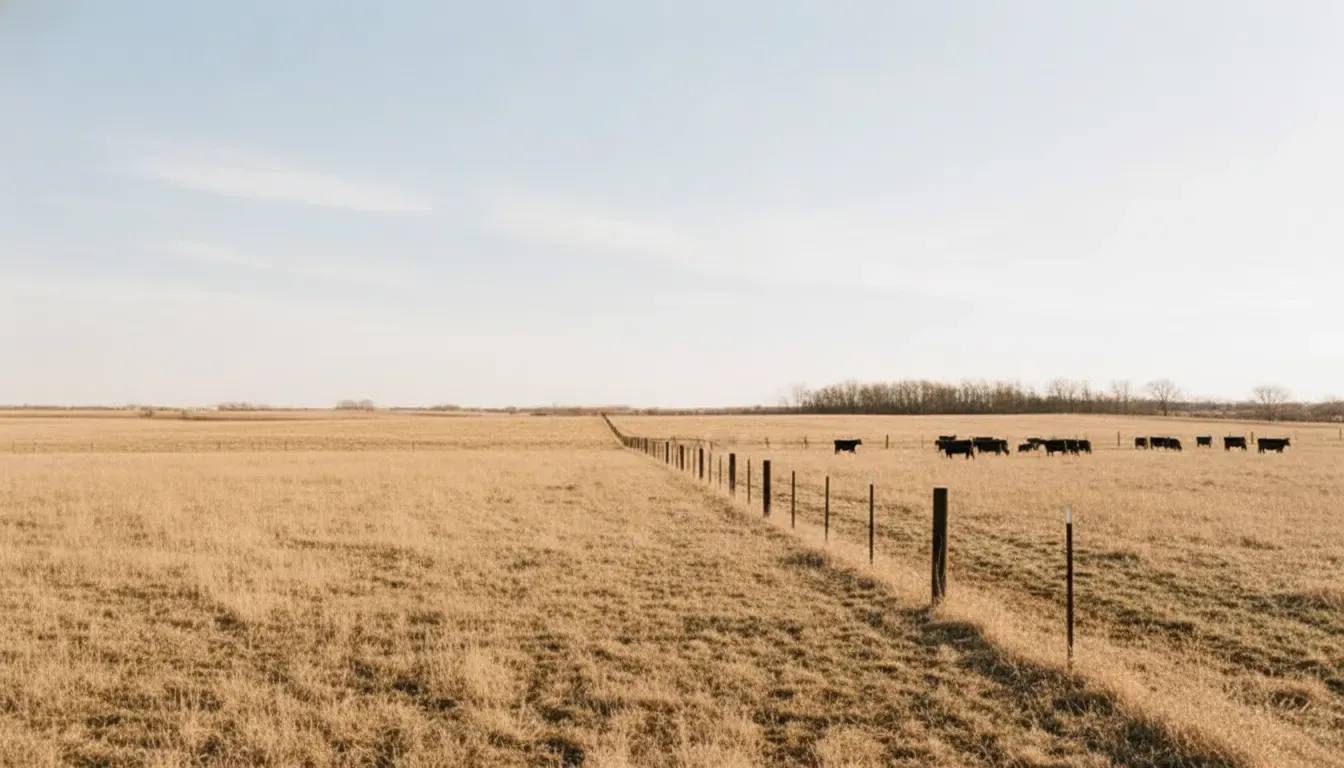
A square is the most perimeter-efficient layout, while a long rectangle uses more fence for the same enclosed area.
How Does Pasture Shape Change the Acreage?
Pasture shape changes acreage because a square encloses the most area for a fixed perimeter, while a narrow rectangle or irregular boundary encloses less. The same 5,280 feet can produce roughly 40 acres in a square, about 38 acres in a moderately long rectangle, or about 25 acres in a very narrow rectangle. Real boundaries can reduce usable acreage further.
For any rectangle, use this formula:
Perimeter = 2 x length + 2 x width
With a one-mile perimeter, the length and width must total 2,640 feet. Here are examples that keep the total perimeter at 5,280 feet:
Layout | Length | Width | Approximate enclosed area |
Square | 1,320 ft | 1,320 ft | 40.0 acres |
Moderate rectangle | 1,640 ft | 1,000 ft | 37.7 acres |
Long rectangle | 1,840 ft | 800 ft | 33.8 acres |
Narrow rectangle | 2,140 ft | 500 ft | 24.6 acres |
The table shows why acreage cannot be determined from fence miles alone. A narrow pasture may be the right shape for access, grazing rotation, or an existing property boundary, even if it is less efficient geometrically. The design should fit livestock movement, water access, gates, machinery, and the way the land is actually used.
Irregular boundaries require a field measurement, map measurement, or survey-based calculation. Trace the proposed fence line, add each segment, and then estimate the enclosed area from a scaled map. Hills, draws, ponds, wooded edges, and setbacks can make a map-only estimate less reliable than a site assessment.
How Can You Calculate Fence Needed for Any Acreage?
For a square field, estimate the fence needed for any acreage by multiplying acres by 43,560, taking the square root to find one side, and multiplying that side by four. This produces the minimum square perimeter for that acreage. A real farm layout may need more fence because of shape, access lanes, gates, terrain, and interior divisions.
- Start with the acreage:
write the area you want to enclose, such as 10, 20, or 40 acres.
- Convert acres to square feet:
multiply the acreage by 43,560.
- Find the square root:
the result is the approximate side length of a square field in feet.
- Multiply by four:
that gives the square perimeter in linear feet.
- Adjust for the actual plan:
add cross-fences, lanes, gates, corners, and boundary changes before ordering materials.
Target acreage | Approximate square side | Square perimeter | Perimeter in miles |
10 acres | 660 ft | 2,640 ft | 0.50 mi |
20 acres | 934 ft | 3,736 ft | 0.71 mi |
40 acres | 1,320 ft | 5,280 ft | 1.00 mi |
80 acres | 1,867 ft | 7,468 ft | 1.41 mi |
These figures are useful for a first conversation, but they do not replace a fence-line walk. Aerial measurements can miss a needed turn around a wet area or a practical gate location. They can also count a property boundary that is not suitable for livestock containment. Rapid Fence can help turn a rough acreage goal into a workable plan for barbwire, hi-tensile, continuous fence, or custom corrals.
How Does Cross-Fencing Change the Math?
Cross-fencing does not change the acreage of the outside parcel, but it adds linear footage because internal fence lines divide the pasture. A 40-acre square has about one mile of exterior fence. If two interior fence runs divide it into four sections, the plan may need about 2,640 additional feet, bringing the total near 7,920 feet, or 1.5 miles, before gates and layout adjustments.
Internal divisions can be worth the additional material and labor when they improve livestock movement, rotational grazing, access control, or protection of a sensitive area. Treat exterior fences and internal fences as separate parts of the plan: the exterior contains the property or pasture, while internal fencing divides it for movement, grazing, or access control.
Plan the interior system at the same time as the perimeter. A gate that looks convenient on the map may create a dead end for a stock trailer. A cross-fence that improves grazing control may also need a lane, a water connection, or a passage for equipment. Counting only the outside boundary can leave the project short on footage and short on function.
What Should Nebraska Farmers Measure Before Requesting a Quote?
Before requesting a quote, measure the proposed perimeter, mark gates and access points, note obstacles, and decide whether the pasture needs internal divisions. Those details help a contractor estimate the actual work instead of relying on acreage alone. Soil, vegetation, existing fence, and terrain also affect the installation plan in Central Nebraska.
- Perimeter:
trace the fence line and record the total linear footage.
- Shape:
identify long runs, sharp corners, curves, creek crossings, and narrow areas.
- Access:
mark field entrances, livestock gates, equipment routes, and trailer access.
- Existing fence:
note sections that need a tear-out, structural repair, or connection to new work.
- Vegetation and dirt work:
identify brush, trees, washouts, steep ground, or areas that need fence line cleaning.
- Livestock:
identify the animals and the pressure the fence must contain.
- Water and handling:
mark ponds, tanks, lanes, corrals, and high-pressure handling areas.
For more detail on choosing a system and planning professional installation, see Rapid Fence's Agricultural Fence Installation guide. Rapid Fence serves agricultural and livestock owners around Scotia and across Central Nebraska, including Greeley, Buffalo, and Hall Counties, with a focus on proper bracing, tension, and durable construction.
What Are the Cost Implications of a One-Mile Fence Plan?
A one-mile perimeter is only one part of project scope, so cost planning should account for fence type, posts, bracing, gates, site preparation, tear-out, terrain, and cross-fencing. Two properties can have the same acreage but require different amounts of work. A square, open pasture with easy access is a different installation from an irregular boundary with heavy clearing and several gates.
Acreage is an area measurement, while fencing is a linear measurement. Cost planning should therefore begin with linear feet and the specific layout. If you are comparing project scope rather than doing geometry, read Rapid Fence's agricultural fence installation cost-per-acre guide for the factors that shape a project estimate. That resource covers cost drivers, while this article focuses on the acreage and perimeter calculation.
When Should You Bring In a Fence Contractor?
Bring in a fence contractor when the layout must follow real property boundaries, the site has difficult terrain, livestock containment is critical, or the plan includes bracing, gates, clearing, and interior divisions. A contractor can walk the proposed line, identify hidden scope, and build a system that fits the operation instead of forcing the land into a perfect geometric example.
Professional planning is especially useful when an old fence is being removed, a new fence must connect to existing sections, or the fence line crosses wet ground and drainage features. Rapid Fence handles fence tear-outs, fence line cleaning, dirt work, professional installation, structural repair, and custom-built corrals in addition to new barbwire, hi-tensile, and continuous fences.
Frequently Asked Questions
One mile of closed fence encloses about 40 acres only in the most efficient square layout. The actual acreage depends on the shape of the boundary, and the total project footage can be higher when you add gates, lanes, cross-fencing, or irregular terrain. These answers give a starting point for planning a site assessment.
How many acres does one mile of fence cover in a square?
One mile of fence encloses about 40 acres in a square. One mile equals 5,280 feet, so each side of the square is 1,320 feet. Multiplying 1,320 by 1,320 gives 1,742,400 square feet, and dividing by 43,560 square feet per acre gives 40 acres.
Does one straight mile of fence enclose any acres?
No. A straight mile is a line, not a closed boundary, so it does not enclose acreage by itself. It must connect with other fences, a property boundary, or a natural barrier to create a closed area. Even then, the shape of the completed boundary determines the acreage.
How much fence do I need for 40 acres?
A square 40-acre parcel needs about one mile of exterior perimeter fence. A rectangular or irregular 40-acre parcel usually needs more than one mile, and a plan with cross-fencing, lanes, or multiple gates needs additional linear footage. Measure the proposed fence line instead of relying on acreage alone.
Is 40 acres always the answer for one mile of fence?
No. Forty acres is the maximum-area benchmark for a one-mile closed perimeter when the layout is square. Long rectangles and irregular boundaries enclose less area with the same perimeter. Natural obstacles, setbacks, and interior divisions can also change how much usable pasture the fence plan creates.
How do I estimate fence for an irregular pasture?
Break the boundary into straight segments, curves, and natural edges, then measure or map each segment and add the lengths. Mark gates, corners, crossings, and interior fences separately. A contractor site visit is the best way to check the map against soil, vegetation, access, livestock needs, and existing fence conditions.
Sources and Math Notes
The area calculations in this article use the standard conversion of one acre to 43,560 square feet and the perimeter and area formulas for squares and rectangles. For additional math background, see the Andrews University perimeter and area reference and the Ohio Digital Mathematics Project fence-enclosure problem.
Written for Rapid Fence by Cody Koehn, CEO.
Comments