
Farm and Ranch Gates: How to Choose

Farm and ranch gates fail when the opening is planned last. A gate that is too narrow scrapes a baler, and a light gate on a weak post sags after one season of cattle pressure. The useful choice is the gate that fits the job at that opening, whether the traffic is livestock, equipment, a driveway, or the mouth of a corral. Width, height, and the posts that carry the leaf matter more than a catalog name.
Call Rapid Fence at (308) 223-1320 to walk the openings and get an estimate.
How to match farm and ranch gates to the job
Start with what has to pass, and how often it passes. A pasture gate that only sorts cattle is a different opening from the one a feed wagon uses every week, and one Central Nebraska ranch often needs all four jobs below. Buying one style for every hole is how gates start dragging within a season.
Opening | What must pass | Gate that usually fits | What fails first |
Pasture or cross fence. | Cattle, horses, or a person on foot. | A livestock gate tall enough that cattle do not reach over it. Hang it on braced end posts. | A short, light gate on a single unbraced post. |
Equipment gap. | The widest machine that uses that field, mirrors included. | A wide steel gate, or a double gate. Set the posts outside the tire path. | A gate measured to the tractor. The baler scrapes it later. |
Driveway or yard. | Trucks, trailers, and daily traffic. | A gate that clears the widest trailer. It must swing or slide clear of the drive. | A swing that hits a snowbank, a ditch, or the truck. |
Corral mouth. | Cattle moving into a pen, plus a person working the gate. | A heavy gate placed for flow, not for looks. | A gate that cattle have to turn hard to enter. |
Pasture gates live on barbwire and hi-tensile lines, and they take shoulder pressure, wind, and the occasional animal that leans through. Equipment gates live where iron meets steel, because a header, a baler, and a feed wagon do not forgive a tight gap. Driveway gates take the most cycles, so if you open one twice a day, hinge wear shows up fast. Corral-mouth gates take the hardest hits, but the layout of those gates belongs in a corral plan, not in a pasture-gate decision. If the opening is the mouth of a working system, read the cattle corral gate placement guide before you order steel.
Hay roads are their own case. A gate that only lets a hay crew in should be planned around delivery width. Livestock that have to stay behind it, and the notes a crew needs before they arrive. That walkthrough is covered in the hay-access fencing and gates guide. Do not treat a hay gate as the pattern for every other hole on the place.
Size the opening from the widest thing that passes
Measure the machine, then add room to miss the posts. The number that matters is the widest point that will actually go through, such as tires, mirrors, a folded header, or the outside of a stock trailer. A gate ordered to the cab width is the gate that gets a dent in June.
Walk the opening with the machine you worry about, or with a tape if that machine is off the place. Note:
The clear width between posts, not the length printed on a gate tag.
Which way the gate must swing or slide so it stays out of the tire path.
Whether ice, a ditch, or a pivot track will block that swing in season.
Whether two leaves are safer than one long leaf that the wind can twist.
A 10-foot or 12-foot leaf is common on pasture and lot openings. It is not automatic. A 12-foot leaf is a specific buy, with its own tube, wire-fill, and bracing questions. When that width is the one you need, use the 12-foot farm gate guide instead of guessing from a shelf tag. If the widest machine is closer to 10 feet of clear opening, stay with that width rather than oversizing a leaf the posts cannot carry.
Double gates help when one leaf would be too long to swing in the wind. They also help when you want a person-width leaf for ordinary days and the full width only for equipment. The center still has to meet and latch. A sagging leaf that misses its mate is not a bargain. It is a gap cattle find.
University of Nebraska-Lincoln Extension's Fence and Water Development for Effective Grazing makes a related point from the grazing side. In its 3-wire high-tensile example, the listed fence cost leaves out the gate. And the crew time listed for the wire also leaves out the time to build that gate. A portable cross fence in the same guide ties into a permanent line at a gate. The gate is part of the grazing system, not a hardware extra you price after the wire is up.
Posts and braces carry the gate, not the wire
A farm gate is a lever, and cattle, wind, and gravity all pull on the latch post and the hinge post. If those posts are the same light line posts as the rest of the fence, the gate drops while the wire still looks tight.
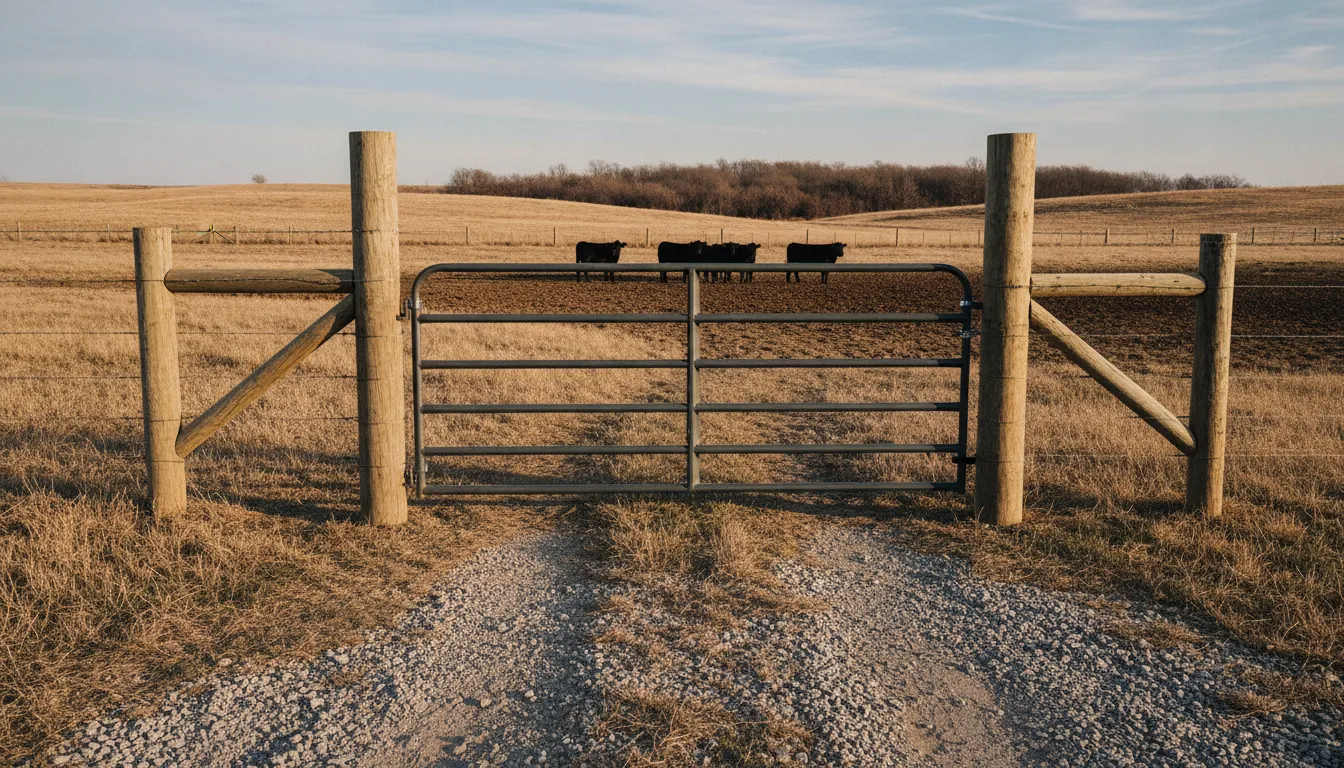
On barbwire and hi-tensile perimeters, the gate belongs between real end posts with a brace that sends the load into the ground. That is the same idea as a corner. The corner brace guide covers how an H-brace or floating brace takes wire tension. Use that thinking at every gate, even a gate in the middle of a straight run. A gate is an end, not a line post with hinges.
Set the posts outside the path, because a post that looks fine in a photo becomes a problem the first time a dual tire kisses it. Depth matters in Central Nebraska soils, especially where the ground heaves or stays wet in spring, because a post that moves an inch at the top will not latch by fall.
Match the fence to the pressure, then hang the gate on that fence's ends. Woven wire and hi-tensile do different work on a pasture. The comparison in the hi-tensile versus woven wire guide is about the line. The gate still needs its own posts. Do not hang a heavy cattle gate in a woven panel that was only meant to hold calves off a water gap.
Hardware is the small steel that makes the big steel work: hinges rated for the leaf. A latch cattle cannot nose open, and a way to adjust after the post settles. The farm gate hardware guide goes through those pieces. For this choice, the rule is simple. Buy the gate and the hangers together, and tell the installer the weight and the width before the posts are set.
Steel choices without turning this into a catalog
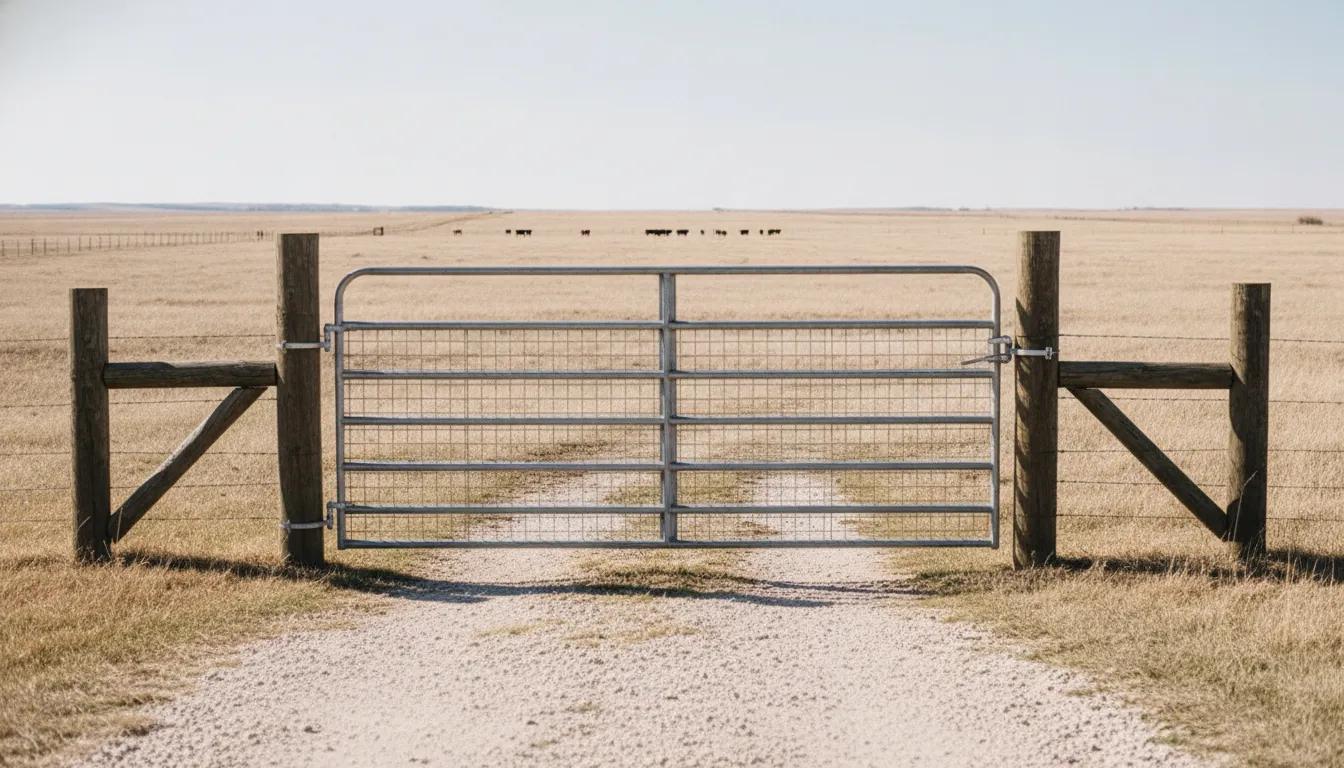
Most working gates on a Nebraska farm or ranch are steel, because wood looks right at a yard entrance and then rots or warps where cattle rub. A light wire-filled gate can be enough on a low-pressure pasture gap. A pipe or tube gate earns its place where cattle push or where people slam the leaf daily. It also earns its place where you do not want to rebuild the opening in five years.
Pipe is its own decision: wall thickness, height, and how the joints are made. That buyer detail lives in the pipe farm gate guide. Galvanized steel resists the wet-dry cycle better than bare metal that you plan to paint and then never paint. Coating checks belong in the galvanized farm gate guide. Use those pages when you already know the opening. Use this page to decide which openings deserve that steel.
Chain link and privacy fence are a different product line, and they suit a yard, a shop, or a place where you want a visual screen. They are a poor default for a cattle perimeter, because cattle lean and a residential panel is not a corral. If a driveway gate is really a yard gate, say so on the estimate. Do not price it like a pasture leaf, and do not hang a pasture gate where the household needs a closer, quieter leaf.
Stay away from product-shopping as the plan. "Farm and ranch gates" on a search page is full of shelf prices and entrance photos. Those prices are not an installed opening in Greeley, Buffalo, Hall, or the counties out toward Boone, Platte, Holt, and Custer. The gate, the posts, the brace, the latch, and the trip are the job. A bare leaf in a cart is not.
Where the gate sits on a Central Nebraska place
Ground decides the swing, so a gate that opens downhill into a ditch, or uphill into a ridge, will fight you every time you use it. A gate on the north side of a shelterbelt can sit in a drift, and a gate under a pivot can be the right width while still blocking the tower. Walk it in the season you will use it, not only on a dry October afternoon.
Think about daily traffic, not the best day.
Mark every opening on a simple map: pasture, lot, driveway, hay road, and corral.
Write what passes through each one, and how often in a normal week.
Note the fence on both sides, the soil, and anything the swing will hit.
Flag gates that cattle rub, because those need heavier leaves and deeper posts.
Flag gates you open from a truck, because those need a latch you can work without a wrestle.
Service from Scotia reaches the home counties and the wider ring about two to three hours out, including Boone, Platte, Holt, and Custer, but soil and wind still change by the section. A sandy ridge and a heavy bottom do not hold a post the same way, so say which one you are on. A gate plan copied from a different county is how posts lean.
If the fence itself is being rebuilt, hang the gates in that project, because a new barbwire line with the old sagging gate left in the middle wastes the brace work. The install sequence for a professional barbwire job, including gates at the end of the line, is in the barbwire installation guide. Rapid Fence builds barbwire, hi-tensile, and continuous fence, plus custom corrals, tear-outs, fence line cleaning, and dirt work. The gate should be in that scope, not added after the crew has left.
What to have ready before you ask for an estimate
An estimate goes faster when the openings are named, and you do not need a perfect drawing to start that conversation. You do need enough detail that someone can tell a pasture gate from a driveway gate without a second trip.
Bring or send:
How many openings, and what each one is for.
The clear width you need, measured from the widest machine or trailer.
Photos of the posts, the brace, and the ground the gate must cross.
Whether cattle, horses, or only equipment use that hole.
Anything in the swing path: a ditch, a drift line, a pivot track, a water tank.
Say if an old gate is still there and whether you want it reused. A bent leaf on good posts is a different job from a straight leaf on posts that have pulled out of the ground. Tear-out of the old opening is part of the work when the posts are done, so do not hide that to make the first number smaller. It shows up the day the crew arrives.
Price follows that scope, and there is no honest shelf price for an installed gate until width, posts, brace, hardware, and travel are known. Ask for the estimate with those facts in hand. If you only know that the west gate is bad, walk it once with a tape before you call. Ten minutes of measuring saves a vague quote that cannot be compared with any other bid.
Call (308) 223-1320 and ask Rapid Fence to price the openings, posts, and braces together.
Frequently asked questions
What size farm and ranch gates do I need?
Size the clear opening to the widest thing that must pass, then add room so tires and mirrors miss the posts. A common pasture leaf is not the right leaf for a baler or a stock trailer. Measure that machine before you order.
Can one gate work for cattle and equipment?
Sometimes, if the cattle gate is wide enough and the posts are built for both pressure and width. Often it is better to keep a livestock gate and an equipment gate as separate openings so neither job compromises the other.
Do farm and ranch gates need their own brace?
Yes. Treat each gate as an end in the fence. Hinge and latch posts need the same kind of brace a corner needs, or the leaf will sag even if the wire stays tight.
Are driveway gates the same as pasture gates?
No. A driveway gate opens more often, has to clear trucks and trailers, and may sit in snow or close to a ditch. A pasture gate is about livestock pressure and a latch that stays shut. Plan them as different openings.
Who installs farm and ranch gates around Scotia, Nebraska?
Rapid Fence installs agricultural gates with barbwire, hi-tensile, and continuous fence from Scotia across Central Nebraska. Including Greeley, Buffalo, and Hall counties and the wider area out toward Boone, Platte, Holt, and Custer. Call (308) 223-1320 to set an estimate.
Comments